BR payments, fiscal & contact
The four rails every Brazilian product ends up needing — Pix, boleto, the NFe access key and holidays / business days — plus the channel all of it reaches the customer through: WhatsApp. Pure TypeScript, no new dependency — the whole slice measures 9.22 KB brotli, Pix alone (payload + CRC + QR component) measures 6.1 KB, and the WhatsApp deep link measures 223 B.
Import from the tempest-react-sdk/br subpath
Like the rest of the BR module, these helpers live in tempest-react-sdk/br, not on the root entry. If you don't import it, you don't pay for it.
import { pixPayload, parseLinhaDigitavel, parseChaveNFe, isBusinessDay, whatsAppUrl } from "tempest-react-sdk/br";
The SDK talks to no bank
Nothing here calls the Brazilian Central Bank, a state tax authority, or a PSP API. These are local encoders and validators: they assemble the right string, verify the check digits and read the fields. Whether a boleto exists, is registered or has already been paid — only a bank can answer. Whether an invoice was authorised — only SEFAZ can.
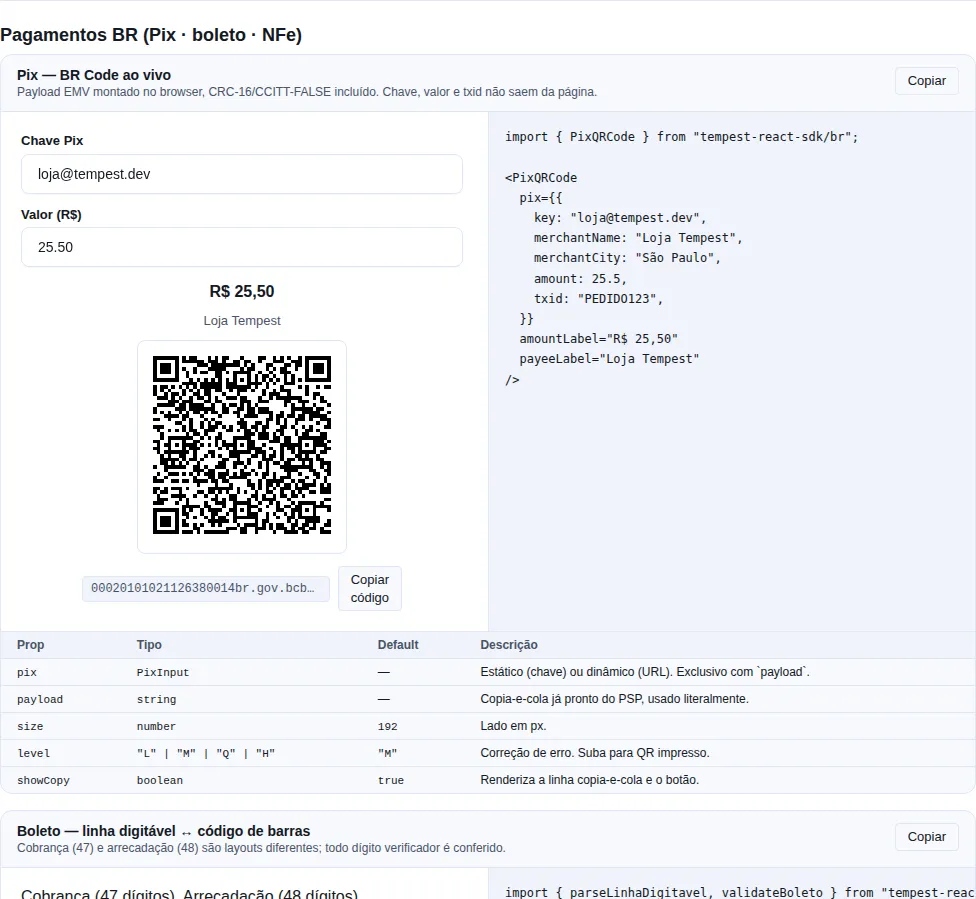
Section br-payments of the gallery — run it locally to interact.
Part 1 — Pix
The problem
A Pix QR is not a "link QR". It is an EMV MPM payload (the EMVCo standard the Central Bank adopted in its "Manual de Padrões para Iniciação do Pix"): a list of ID + 2-digit length + value triples, closed by a CRC-16.
Writing that by hand fails in the same place every time — the checksum. It is CRC-16/CCITT-FALSE (polynomial 0x1021, initial value 0xFFFF) computed over everything before it plus the literal 6304, that is, including the header of tag 63 itself. Get that wrong and you ship a QR that opens in the app and fails to scan.
The short path: <PixQRCode>
import { PixQRCode } from "tempest-react-sdk/br";

export function CheckoutPix() {
  return (
    <PixQRCode
      pix={{
        key: "loja@tempest.dev",
        merchantName: "Loja Tempest",
        merchantCity: "São Paulo",
        amount: 25.5,
        txid: "PEDIDO123",
      }}
      amountLabel="R$ 25,50"
      payeeLabel="Loja Tempest"
    />
  );
}
That renders the symbol and the copy-and-paste line with a copy button. The two together are not decoration:
Never render the QR alone
In a mobile checkout the QR appears on the same device that would scan it. Without the copyable string the user is stuck. It is the single most common mistake in a Pix screen.
The payload is built in the browser and the symbol is drawn by the SDK's own encoder (the same one behind QRCode). Key, amount and txid never leave the page — a QR-image service would receive all three.
When the payload comes ready from your PSP (a signed dynamic charge), pass it straight through:
<PixQRCode payload={charge.brcode} level="Q" size={220} />
pix and payload are mutually exclusive
Passing both throws PixError. Prefer payload for a dynamic charge: the PSP issued that string, and rebuilding it here only adds a way to get it wrong.
pixPayload — the string, no UI
import { pixPayload } from "tempest-react-sdk/br";

const payload = pixPayload({
  key: "12345678909",
  merchantName: "Loja Tempest",
  merchantCity: "Sao Paulo",
  amount: 25.5,
  txid: "PEDIDO123",
});

// 00020101021126330014br.gov.bcb.pix0111123456789095204000053039865405
// 25.505802BR5912Loja Tempest6009Sao Paulo62130509PEDIDO1236304D68C
Accepted fields:
| Field | Tag | Required | Note |
|---|---|---|---|
key |
26 / 01 | ✅ | CPF, CNPJ, e-mail, phone or EVP. Validated and normalised. |
merchantName |
59 | ✅ | Max 25 characters. Longer throws. |
merchantCity |
60 | ✅ | Max 15 characters. |
amount |
54 | — | BRL. Omit to let the payer type the value. |
txid |
62 / 05 | — | [A-Za-z0-9]{1,25}. Defaults to ***. |
description |
26 / 02 | — | Free text some wallets show. |
postalCode |
61 | — | CEP, digits only. |
oneTime |
01 | — | true → tag 12 (single use) instead of 11. |
Static vs dynamic
The distinction changes what settles, so it is not cosmetic:
Tag 26 carries the key. The QR is self-contained, printable and reusable. With amount omitted it settles against whatever the payer typed.
pixPayload({
  key: "loja@tempest.dev",
  merchantName: "Tempest",
  merchantCity: "Belo Horizonte",
});
Tag 26 carries a URL (payloadLocation), and the wallet fetches amount and payee from the PSP. It settles against what the PSP served. Defaults to single use.
pixPayload({
  kind: "dynamic",
  url: "pix.example.com/qr/v2/abc123",
  merchantName: "Tempest",
  merchantCity: "Recife",
});
A charge that must reconcile to the cent needs the dynamic form
A static QR with no amount settles against what the payer typed — including R$ 1.00 on a R$ 100.00 invoice.
Keys: validation, and the eleven-digit trap
import { normalizePixKey, pixKeyType } from "tempest-react-sdk/br";

pixKeyType("123.456.789-09"); // "cpf"
pixKeyType("11.222.333/0001-81"); // "cnpj"
pixKeyType("loja@tempest.dev"); // "email"
pixKeyType("+5511987654321"); // "phone"
pixKeyType("123e4567-e89b-12d3-a456-426614174000"); // "evp"
pixKeyType("not a key"); // null

normalizePixKey("(11) 98765-4321"); // { type: "phone", value: "+5511987654321" }
CPF and CNPJ go through validateCPF / validateCNPJ (the same ones as BR Forms) — a key whose check digits fail is rejected with PixError.
A CPF and a national mobile number are both eleven digits
"11987654321" is a valid mobile and could be a CPF. The check digits break the tie: eleven digits with a valid DV become "cpf", anything else becomes "phone". Pass phone keys as +5511987654321 and the ambiguity is gone.
Accents
The BR Code character set has no room for accents. The SDK strips diacritics and rejects whatever is left outside printable ASCII:
pixPayload({ key: "…", merchantName: "Padaria Açúcar", merchantCity: "São Paulo" });
// → "5914Padaria Acucar" … "6009Sao Paulo"

pixPayload({ key: "…", merchantName: "Loja ✅", merchantCity: "Recife" });
// → PixError: merchantName has characters the BR Code cannot carry
Why strip instead of throw
"São Paulo" is the city's real name and the payload cannot carry it. A QR that does not scan is worse than a name without its tilde. An emoji, on the other hand, is a caller mistake, and that one surfaces.
Reading a payload back
import { parsePixPayload } from "tempest-react-sdk/br";

const data = parsePixPayload(pasted);
data.key; // "12345678909"
data.amount; // 25.5
data.txid; // "PEDIDO123"
data.crcValid; // true
data.fields; // every TLV, in order, unknown ones included
It is tolerant of unknown tags — PSPs do add their own templates, and a reader that rejects them is useless in production. What is not tolerated: a broken frame (a length that runs past the end, a missing 6304) and a CRC mismatch, which throws. To inspect a payload you already know is corrupt:
parsePixPayload(pasted, { requireCrc: false }); // crcValid: false, no throw
A CRC mismatch is not a warning
A BR Code whose checksum fails was corrupted in transit, and the account it now points at is not the account the payee published. That is why the default throws.
The CRC detects corruption, not authorship: whoever crafts a payload recomputes the checksum, so a valid CRC says nothing about who published the account. That is why the reader also refuses a payload with two readings — the preview would show one, and the bank's wallet may pay the other:
Refused (PixError) |
Why |
|---|---|
a tag repeated at the root (54, 59, 26, …) |
the Central Bank's BR Code manual, citing EMV® QRCPS-MPM: no duplicate IDs in the root |
a sub-tag repeated inside 26 or 62 (two 01 keys, two 05 txids) |
the same ambiguity one level down; no conforming emitter repeats one |
a tag 63 before the end (a 6304 + CRC mid-payload, followed by more tags and a second 6304 + CRC) |
EMV® QRCPS-MPM, which the Bacen manual follows, makes 63 the last object; cut at the first CRC, the same text is another valid payload, without the 54 that follows |
a first tag other than 00 (Payload Format Indicator) |
the same EMV spec makes 00 the first object; every other root tag may come in any order |
a tag 26 with a key (01) and a URL (25) |
a BR Code is static or dynamic, not both |
a tag 54 outside the EMV format: 1e3, -1, ,5, 0x10, 1.005, over 13 characters |
digits and one . decimal mark only, up to two decimals (BRL) — what Number() would read as 1000, -1, NaN or 16 |
"98" and "98." still parse: EMV allows the . with no decimals. Zero ("0", "0.00") reads as amount: 0, because the Central Bank's BR Code manual lists "0" as a tag 54 example — the reader tolerates what the Bacen spec accepts. pixPayload still refuses a non-positive amount — checked after rounding, so 0.004 throws instead of writing "0.00" — and refuses text outside the EMV common character set (printable ASCII), such as a joão@example.com key — name, city and description lose their accents before the check ("São Paulo" → "Sao Paulo", case kept) and only throw if an emoji or CJK is left; the key is not transliterated, because another spelling is another key: each TLV length counts characters, and only in that set do a character, a UTF-16 unit and a byte coincide. When reading, lengths count characters, so another PSP's template with non-ASCII text does not misalign the tags after it.
pixCrc16, if you need the checksum alone
import { pixCrc16 } from "tempest-react-sdk/br";

pixCrc16("123456789"); // "29B1" — the published CRC-16/CCITT-FALSE check value
pixCrc16(payload.slice(0, -4)); // the four hex characters that close the payload
Part 2 — Boleto
Two layouts, the same length
The barcode is 44 digits in both cases, and that is where the bug lives:
| First digit | Typed line | Used for | |
|---|---|---|---|
Cobrança ("banco") |
≠ 8 | 47 digits | A bank boleto against an invoice |
Arrecadação ("arrecadacao") |
8 |
48 digits | Utility, tax, traffic fine |
They are not variants of one format: every field moves position and meaning. The SDK detects the layout from the first digit and returns a discriminated union — narrow on kind before reading it.
Reading what the scanner handed you
import { parseCodigoBarras, parseLinhaDigitavel } from "tempest-react-sdk/br";

const boleto = parseCodigoBarras("34191157000001234560000123456789012345678901");

if (boleto.kind === "banco") {
  boleto.banco; // "341"
  boleto.valor; // 1234.56
  boleto.vencimento; // Date — 2026-09-15
  boleto.linhaDigitavel; // 47 digits, check digits included
} else {
  boleto.segmentoLabel; // "Órgãos governamentais"
  boleto.valor; // BRL, or null when the field is a reference
  boleto.empresa; // FEBRABAN code, or a CNPJ prefix on segmento 6
}
parseLinhaDigitavel goes the other way and accepts both lines (47 or 48). Both parsers verify every check digit the layout allows checking: the 3 (bank) or 4 (arrecadação) block digits, plus the general one. Any of them wrong throws BoletoError naming which.
Explicit conversion, when you only want the other representation:
import { codigoBarrasToLinhaDigitavel, linhaDigitavelToCodigoBarras } from "tempest-react-sdk/br";

linhaDigitavelToCodigoBarras("34190000172345678901723456789017115700000123456");
// "34191157000001234560000123456789012345678901"
Validating typed input
import { formatLinhaDigitavel, validateBoleto } from "tempest-react-sdk/br";

validateBoleto(input); // true / false, never throws
formatLinhaDigitavel(input);
// "34190.00017 23456.789017 23456.789017 1 15700000123456"
formatLinhaDigitavel is a display helper: input that is neither 47 nor 48 digits comes back untouched.
Layout only, without parsing: boletoKind
To branch the UI before validating (show the right field, pick the icon),
boletoKind reports the layout from the length and the first digit, and returns
null for input that is not a slip — without throwing:
import { boletoKind } from "tempest-react-sdk/br";

boletoKind("34191157000001234560000123456789012345678901"); // "banco"
boletoKind("848900000017..."); // "arrecadacao"
boletoKind("123"); // null
And boletoDueDate(fator, options?) resolves the due-date factor on its own —
useful when the factor arrived from another system and you do not hold the whole
barcode. It returns { date, epoch } (telling you which base was used) or
null when the factor is 0, which is the "no due date" value:
import { boletoDueDate } from "tempest-react-sdk/br";

boletoDueDate(1000, { epoch: "legacy" }); // { date: 2000-07-03, epoch: "legacy" }
boletoDueDate(1000, { epoch: "current" }); // { date: 2025-02-22, epoch: "current" }
boletoDueDate(0); // null
The returned epoch matters: it says which of the two ambiguous readings
(below) came out, which is the difference between showing the date and showing
the right date.
The February 2025 due-date rollover
The due date is not stored as a date. It is a fator de vencimento: four digits counting days from a base date. And that base date changed:
- Original base 1997-10-07. The field saturated at
9999on 2025-02-21. - From 2025-02-22 the counter restarted at
1000against a new base of 2022-05-29 (FEBRABAN communication FB-009/2023).
The two readings are genuinely ambiguous
Every fator from 1000 to 9999 has a reading under each base — the old one lands in 2000-07-03 … 2025-02-21, the new one in 2025-02-22 … 2049-10-14. Nothing in the barcode says which.
The "auto" default picks whichever falls nearer reference (today, by default). That is right for the case that matters — a slip being paid now — and wrong for an archive sweep. When you know, say so:
parseCodigoBarras(barcode, { epoch: "current" }); // base 2022-05-29
parseCodigoBarras(barcode, { epoch: "legacy" }); // base 1997-10-07
parseCodigoBarras(barcode, { reference: new Date(2025, 5, 1) });
The resolved field comes with the base it was read under, so the UI can warn:
const boleto = parseCodigoBarras(barcode);
if (boleto.kind === "banco") {
  boleto.fatorVencimento; // 1570
  boleto.vencimentoEpoch; // "current"
  boleto.vencimento; // Date, or null when the fator is 0 (no due date)
}
To issue one, the inverse:
import { fatorVencimento } from "tempest-react-sdk/br";

fatorVencimento(new Date(2025, 1, 22)); // 1000 — current base
fatorVencimento(new Date(2025, 1, 21), "legacy"); // 9999
fatorVencimento(new Date(2020, 0, 1)); // BoletoError — no fator represents it
Arrecadação: what is read and what is not
Position 3 says two things at once — whether the value is money, and which modulo computes the general check digit:
| Position 3 | Value | General DV |
|---|---|---|
6 |
BRL | módulo 10 |
7 |
Currency quantity / reference | módulo 10 |
8 |
BRL | módulo 11 |
9 |
Currency quantity / reference | módulo 11 |
With 7 or 9, valor comes back null and the raw field stays in valorRaw — the SDK does not pretend a reference is money. A position 3 outside 6-9 is rejected rather than mis-read.
vencimentoCampoLivre is a hint, not a settlement date
The layout says a due date, if present, occupies the first eight digits of the campo livre as AAAAMMDD. But the field is optional and nothing marks its presence, so a campo livre that merely looks like a date lands there too. Use it in a UI; never to settle.
The three check digits, exported
They show up in any FEBRABAN integration, so they are on the barrel:
import { mod10Dac, mod11DacArrecadacao, mod11DacCobranca } from "tempest-react-sdk/br";

mod10Dac("01230067896"); // 3 — the worked example in the FEBRABAN v7 layout
Cobrança módulo 11 ≠ arrecadação módulo 11
Same weights, same subtraction — and different rules for the degenerate remainders. Cobrança resolves remainders 0, 1 and 10 to 1; arrecadação resolves 0 and 1 to 0. Using one on the other's layout produces a wrong digit exactly 3 times in 11, which passes a small-sample test. That is why they are separate functions.
Part 3 — NFe access key
The 44 digits that identify any Brazilian electronic fiscal document:
35 2601 12345678000195 55 001 000000123 1 12345678 5
cUF AAMM CNPJ           mod série nNF    tp cNF     cDV
import { formatChaveNFe, parseChaveNFe, validateChaveNFe } from "tempest-react-sdk/br";

validateChaveNFe(input); // true / false

const chave = parseChaveNFe("35260112345678000195550010000001231123456785");
chave.uf; // "SP" — the br module's own UF type
chave.ano; // 2026
chave.mes; // 1
chave.cnpj; // "12345678000195"
chave.modeloLabel; // "NF-e"
chave.serie; // "001"
chave.numero; // "000000123"
chave.tipoEmissaoLabel; // "Normal"
chave.dv; // "5"

formatChaveNFe("35260112345678000195550010000001231123456785");
// "3526 0112 3456 7800 0195 5500 1000 0001 2311 2345 6785"
validateChaveNFe checks three things: 44 digits, a cUF that is a real federative unit, and a check digit that recomputes (módulo 11, weights 2–9 right to left, remainder 0 or 1 → digit 0).
The layout is shared — modelo is what tells you which document you hold
NF-e (55), NFC-e (65), CT-e (57), MDF-e (58), BP-e (63), NF3e (66)… all use the same 44-digit key. A model outside the table comes back with modeloLabel: null rather than a guess.
The cUF resolves into the UF type
chave.uf is the same UF union that citiesByUf, getState and BrazilMap use, so it chains straight into the rest of the BR module.
Issuing: computing the check digit and handling the error
Code that builds a key (rather than reading a finished one) needs the check
digit over the first 43 digits. chaveNFeCheckDigit does that calculation on
its own, and throws ChaveNFeError when the body is not exactly 43 digits:
import { ChaveNFeError, chaveNFeCheckDigit } from "tempest-react-sdk/br";

const body = "3526011234567800019555001000000123112345678"; // 43 digits

try {
  const dv = chaveNFeCheckDigit(body); // 5
  const chave = `${body}${dv}`;
} catch (err) {
  if (err instanceof ChaveNFeError) console.error(err.message);
}
ChaveNFeError is the NFe group's only exception — validateChaveNFe still
returns false instead of throwing, because validating user input is not an
exceptional case.
Part 4 — Holidays and business days
What is in the table
import { holidaysFor } from "tempest-react-sdk/br";

holidaysFor(2026);
// 13 entries: 9 national holidays + 4 movable days the financial system observes
Each entry carries date (YYYY-MM-DD), name, movable and a kind:
"national"— a feriado nacional in federal law. Nine fixed dates (Lei 662/1949 as amended by Lei 10.607/2002, Lei 6.802/1980 for 12 October, Lei 14.759/2023 for 20 November)."banking"— not a statutory holiday, but a day the financial system does not operate: Carnaval (Monday and Tuesday), Good Friday and Corpus Christi. Branches shut, compensation stopped — a boleto or a wire dated there settles later.
Why both kinds exist
Carnaval and Corpus Christi are not national holidays by law — yet CMN Resolução 4.880/2020 closes the banks on all four days. If you compute a payment deadline, both count; if you compute a labour obligation, only "national" does. The default is the banking calendar, because that is the one that breaks money:
isBusinessDay("2026-04-03"); // false — Good Friday
isBusinessDay("2026-04-03", { kinds: ["national"] }); // true
What is not in it, and will not be
State and municipal holidays are not covered
The data magna varies by state and each of the 5,570 municipalities may declare its own, including up to four religious days. No table stays both complete and current. Pass them through extra:
const SAO_PAULO = ["2026-01-25", "2026-07-09", "2026-11-20"];
isBusinessDay("2026-07-09", { extra: SAO_PAULO }); // false
Also deliberately out:
- Ponto facultativo. A federal decree letting public servants off is not a holiday and moves nobody's deadline.
- Pre-2002 history. The table encodes the law as it stands today. Asking for 1998 returns today's set shifted to 1998, not what was in force then. The one exception modelled is 20 November, which only appears from 2024.
Business-day arithmetic
import { addBusinessDays, isBusinessDay, isHoliday, nextBusinessDay } from "tempest-react-sdk/br";

isHoliday("2026-11-20"); // true
isBusinessDay("2026-08-03"); // true — an ordinary Monday

nextBusinessDay("2026-12-24"); // 2026-12-28 — skips Christmas and the weekend
addBusinessDays("2026-04-01", 2); // 2026-04-06 — skips Good Friday and the weekend
addBusinessDays("2026-04-06", -2); // 2026-04-01 — a negative count walks back
They accept a Date or "YYYY-MM-DD" and return a Date at local midnight.
Everything is the local calendar, never UTC
"Is today a holiday?" is a question about the calendar of whoever is looking. The helpers use getFullYear/getMonth/getDate and build with new Date(y, m, d); going through toISOString() would shift the day for every viewer east of Greenwich.
addBusinessDays(date, 0) returns the day untouched
Even when it is not a business day. Snapping silently would hide exactly the case you need to see.
Where Easter comes in
The four movable days are derived from Easter Sunday, not listed:
import { easterSunday } from "tempest-react-sdk/br";

easterSunday(2026); // 2026-04-05
It is the anonymous Gregorian computus (Meeus/Jones/Butcher): integer arithmetic over the year, no table and no dependency — exact for every Gregorian year.
Part 5 — WhatsApp
The Pix is assembled, the boleto is parsed, the slot is booked. What is left is the part no encoder solves: telling the person. In Brazil that happens on WhatsApp, and the piece every project rewrites is not the copy — it is normalising the number and building the URL.
A deep link, never a send
import { openWhatsApp, toWhatsAppNumber, whatsAppUrl } from "tempest-react-sdk/br";

toWhatsAppNumber("(11) 99999-8888"); // "5511999998888"
whatsAppUrl("(11) 99999-8888", "Seu horário é amanhã às 14h.");
// "https://wa.me/5511999998888?text=Seu%20hor%C3%A1rio%20%C3%A9%20amanh%C3%A3%20%C3%A0s%2014h."

openWhatsApp("(11) 99999-8888", "Seu horário é amanhã às 14h."); // opens the tab, returns true
Opening the chat is the feature, not the limitation
The link opens WhatsApp with the message ready and the person presses send. No official API, no approved template, no business verification — and, above all, the UI never claims a message was delivered when it was only typed. Automated sending is a different product (the Cloud API), with a different cost and a different responsibility.
Why the 55 is not a detail
A Brazilian phone number is stored almost everywhere without its country code: ten digits for a landline, eleven for a mobile. wa.me refuses anything that is not fully qualified. toWhatsAppNumber puts 55 in front of those two shapes, and returns untouched a number that already carries a country code (12 to 15 digits, the E.164 range no Brazilian national number can reach) — so a foreign client's mobile works too.
toWhatsAppNumber("11999998888"); // "5511999998888"  — national mobile
toWhatsAppNumber("1133334444"); // "551133334444"   — national landline
toWhatsAppNumber("+55 11 99999-8888"); // "5511999998888"  — already qualified
toWhatsAppNumber("+351 912 345 678"); // "351912345678"   — Portugal, untouched
A number that cannot be normalised returns "" — on purpose
Handing back the digits as typed is what the naive version does, and the result is a wa.me URL that opens WhatsApp on a number nobody owns. Here a typo becomes a disabled button, not a dead chat window:
const url = whatsAppUrl(client.phone, greeting);

<Button disabled={!url} onClick={() => openWhatsApp(client.phone, greeting)}>
    Message on WhatsApp
</Button>
Trunk and carrier prefixes (0, 021) are not stripped
A leading zero is ambiguous between long-distance dialling and carrier selection, so a number carrying one reads as invalid instead of being reinterpreted in the dark. The zero is what rules out 011999998888 even at a plausible 12 digits: no E.164 country code starts with 0, so that is a national number wearing a prefix, never an international one.
The ninth digit belongs to your database, not to the link
A mobile stored before 2016 has ten digits and reads as a landline here — the link is built and WhatsApp decides whether it finds the account. If your records go back that far, normalise the ninth digit in the database; a deep link cannot guess whether 1133334444 is a landline or a mobile missing its 9.
Recipe: asking for the deposit over WhatsApp
The case that ties this part back to Part 1 — the message body carries the Pix copy-and-paste string:
import { openWhatsApp, pixPayload } from "tempest-react-sdk/br";
import { Button } from "tempest-react-sdk";

interface Booking {
    clientName: string;
    clientPhone: string;
    depositBRL: number;
}

export function DepositRequestButton({ booking }: { booking: Booking }) {
    function requestDeposit(): void {
        const payload = pixPayload({
            key: "financeiro@studio.com.br",
            merchantName: "Studio Aurora",
            merchantCity: "SAO PAULO",
            amount: booking.depositBRL,
        });

        openWhatsApp(
            booking.clientPhone,
            [
                `Oi, ${booking.clientName}! Para confirmar seu horário, o sinal é de R$ ${booking.depositBRL.toFixed(2)}.`,
                "",
                "Pix copia e cola:",
                payload,
            ].join("\n"),
        );
    }

    return <Button onClick={requestDeposit}>Pedir sinal no WhatsApp</Button>;
}
openWhatsApp reports the request, not the tab
true means "the number was usable and the open was requested". Opening with noopener makes window.open return null even on success, so its result cannot tell a blocked popup from an opened tab — and promising otherwise would be a lie. Outside a browser (test runner, service worker, build plugin) it returns false instead of throwing.
Recap
- Pix —
pixPayloadassembles the EMV BR Code with the right CRC-16/CCITT-FALSE (the literal6304included);parsePixPayloadreads it back, tolerant of unknown tags and intolerant of a bad checksum, a repeated tag and an amount outside the EMV format;<PixQRCode>draws the symbol and the copy-and-paste line, because on a phone the QR alone is useless. - Boleto —
parseLinhaDigitavel/parseCodigoBarrasconvert 47↔44 and 48↔44 while verifying every check digit; cobrança and arrecadação are different layouts and the SDK never conflates them; the fator de vencimento has two bases since February 2025 and the choice is explicit. - NFe —
parseChaveNFeopens the 44 digits and resolvescUFinto the module'sUFtype;validateChaveNFechecks length, UF and check digit. - Holidays —
holidaysForreturns the 9 national holidays plus the 4 movable banking days, labelled; state and municipal days come in throughextra;isBusinessDay/nextBusinessDay/addBusinessDaysdo the arithmetic in the local calendar. - WhatsApp —
toWhatsAppNumberputs55in front of a national number and returns""for anything undialable;whatsAppUrlbuilds thewa.melink with the text encoded;openWhatsAppopens the tab. It is a deep link, never a send: the person presses send.
None of this talks to a bank. For the server side (registering a boleto, creating a Pix charge, authorising an invoice), see FastAPI integration.